Tampa Bay Florida, Fall 2026

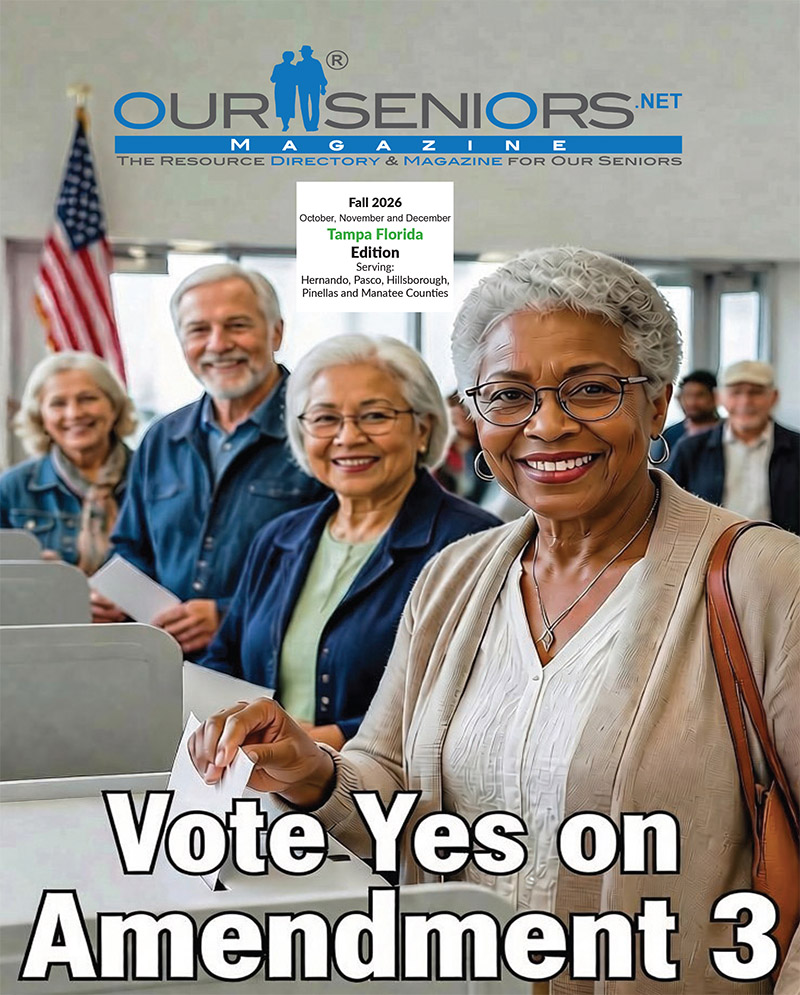
Tampa Bay Florida Fall 2026 Edition – OurSeniors.net Magazine
Autumn has arrived, and the Tampa Bay Florida Fall 2026 Issue of OurSeniors.net Magazine is now ready for you to read. Furthermore, remember to cast your No vote on Amendment 1 and YES on Amendments 2 and 3 on November 3rd. We appreciate OurSeniors!
Contents
Fall 2026 | Volume X | Issue 3








In the News
4. Vote Yes on Amendment 3
Community
10. A Guide to Returning to School in Retirement for Growth and Purpose
20. Donate While You Dine and 50/50 Raffle Events
Entertainment
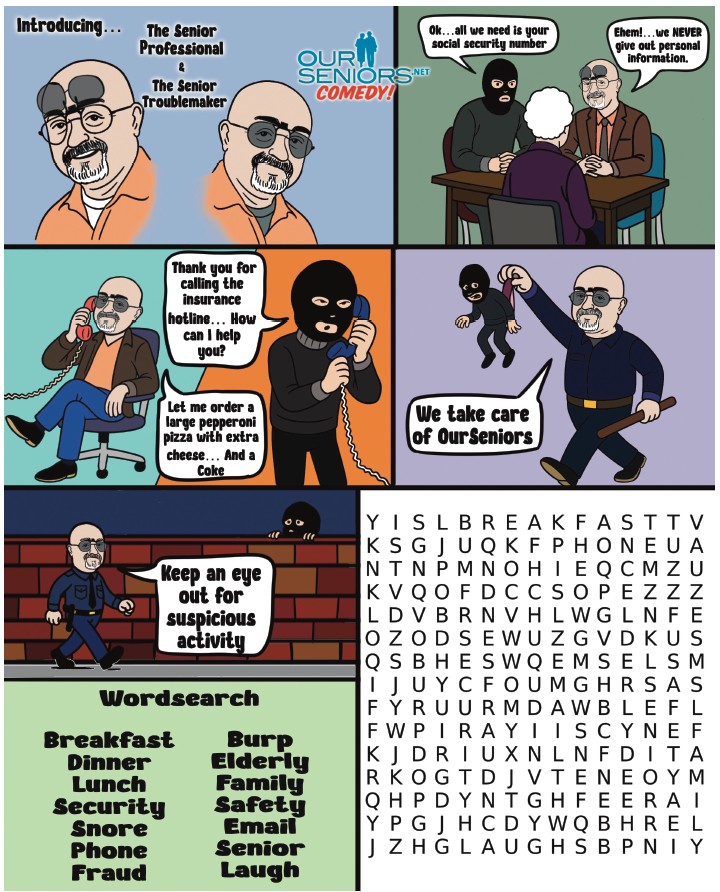
15. OurSeniors Comedy
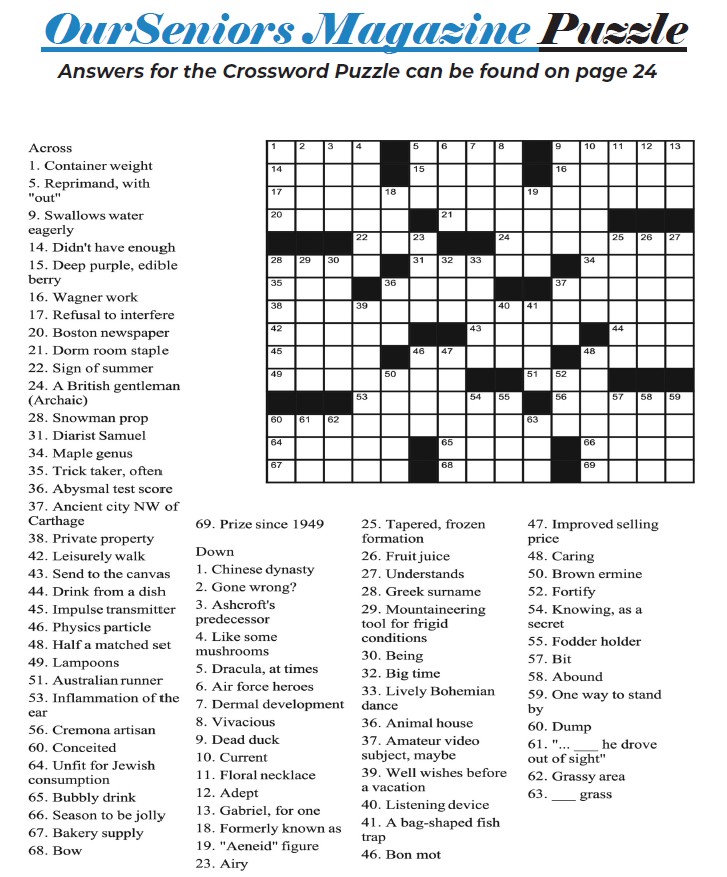
17. Crossword Puzzle for OurSeniors
Fraud & Security
14. Stopping Tech Support Scammers in their Tracks
18. The Long and Winding Road from Fingerprinting to DNA Mapping to Artificial Intelligence to Crime Solving
Health & Wellness
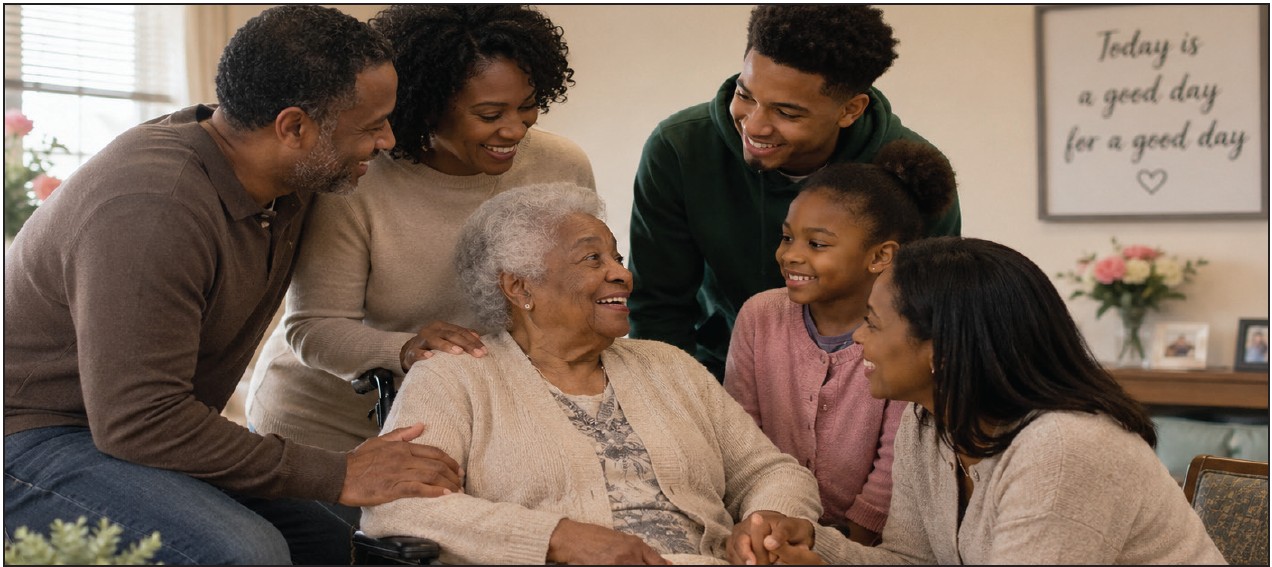
5. Why is it important to visit Loved Ones in Nursing Homes
8. Are You Caring for Elderly Parents? Here’s What You Should Understand
12. How Embracing New Skills Boosts Confidence and Growth After 60
Inspirational
7. The Curious Heart Never Ages – Sally Birsinger’s Lifetime of Learning
Don’t miss another edition by donating! Visit OurSeniors.org/donate
Disclaimer: The information published in this magazine and our website is intended for residents of the USA. The opinions, beliefs and viewpoints expressed by the various authors in this magazine and on this web site do not necessarily reflect the opinions, beliefs and viewpoints of OurSeniors.net Magazine or official policies of OurSeniors.net Magazine, OurSeniors Radio, OurSeniors Discounts, OurSeniors.org, Inc., OurSeniors.com and or its related entities. It may contain general information about medical conditions, public and private health service organizations and other third-party information including but not limited to testimonials. The information is not advice (legal, medical or otherwise) and should not be treated as such. Consult your licensed Professional such as Attorney and or Doctor etc. for further advice. No claim is made as to the accuracy, authenticity or completeness of any information and, is often provided in a generalized or summarized format for brevity. OurSeniors.net Magazine, LLC and or its subsidiaries, does not accept any liability for the information (nor for the use of any information) provided by this magazine and or website. The information presented by this magazine and website is provided on the basis that all viewers undertake responsibility for assessing the relevance and accuracy of the data related to their circumstances. Thank you for reading our magazine and visiting www.OurSeniors.net and please contact us if we can be of further assistance. All real estate advertised in OurSeniors.net is subject to the Federal Fair Housing Act. This federal law makes it illegal to advertise any preference, limitation or discrimination based on race, color, religion, sex, handicap, familial status, or national origin, or intention to make any such preferences, limitation, or discrimination. We will not knowingly accept any advertising for real estate which violates the law. All persons are hereby informed that all real estate advertised in OurSeniors.net is available on an equal opportunity basis. Information contained herein has been furnished by community owners, managers and agents. OurSeniors.net and or OurSeniors.online, OurSeniorsDiscounts.net and or OurSeniors.org, Inc. and OurSeniors.net Magazine, LLC do not make any representations as to opinions and facts. All terms and conditions of rentals are subject to change. OurSeniors.net reserves the right to refuse advertising space to anyone deemed unsuitable for placement in this publication. OurSeniors.net, OurSeniors.online, OurSeniorsDiscounts.net and or OurSeniors.org, Inc., and OurSeniors.net Magazine, LLC retains all rights reserved by copyright 2023 OurSeniors.net, and or OurSeniors.net Magazine, LLC. This publication or parts thereof may not be reproduced in any form without the written permission of the publisher. For further Disclaimer information please visit www.ourseniors.net and click Disclaimer on the footer of the website. Please note that websites and links are referenced in the magazine, and you may have complete access to our online version by visiting www.ourseniors.net/editions.

To Our Valued Readers, Subscribers, Vendors, and Donors of OurSeniors,
One Straightforward Message to Our Readers
What enables OurSeniors.org and family to keep aiding seniors across Florida? A significant factor is the gracious backing from our donors and sponsors such as those found at https://www.ourseniors.org/partnership-levels/, along with the listing of our present donors available here: https://www.ourseniors.org/fundraiser/. Are you prepared to assist OurSeniors and join the ranks of our donors? While you engage with our print publication, OurSeniors.Net Magazine, or view it online, kindly remember these excellent businesses and professional services. By supporting them, you contribute to the continuance of OurSeniors’ numerous free services and resources.
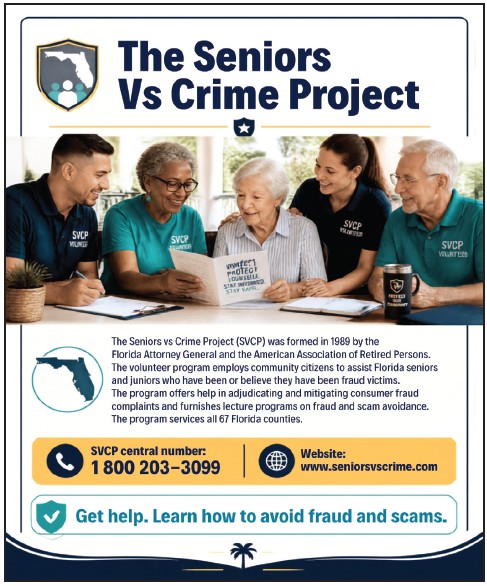
Among the complimentary services we offer are distinctive programs like our partnership with the Seniors Versus Crime initiative from the Florida Attorney General. The Seniors Vs Crime Project aims to diminish the victimization of elder individuals who are targeted for particular crimes or scams linked to their age. This program operates throughout all 67 counties in Florida, assisting senior victims of fraud in reclaiming their lost assets.
As seniors navigate various challenges with age, the OurSeniors Team has been established to aid those seeking support. We address logistical hurdles such as locating caregiver services, resolving transportation issues, providing assistance with medications, and addressing numerous other concerns. OurSeniors is a No-Cost Resource, supplying information and guiding seniors to our trusted, qualified professionals. We can assist in finding services related to asset protection, estate planning, or retirement planning.
Recognized as the top senior-focused publication in Florida, OurSeniors.Net Magazine is published quarterly, delivering entertainment, news, and motivation to the elder community. The “Amazing Senior” segment celebrates the achievements and experiences of extraordinary seniors from The Greatest Generation. These narratives reflect real-life accomplishments, challenges, and resilience that inspire all of us. You can explore these inspiring stories here: https://ourseniors.net/editions/amazing-seniors/
All these services are offered at no cost to seniors and their families. If you are reading this letter today, you also have the chance to make a positive impact! To keep providing these Complimentary Resources to our expanding community, we urgently need your Donation! OPERATION Support OurSeniors.org presents an effortless way for you to contribute. Every donation helps ensure that our publications and services remain accessible for the seniors who require them. As a 501 C (3) nonprofit organization, donations made are eligible for tax deductions.
For further information, please visit www.OurSeniors.org/donate. Seniors appreciate our magazine and various services, yet we need your assistance to persist in serving the elderly. The escalating expenses connected to producing and distributing OurSeniors.Net Magazine and other services have rendered this quite challenging. Making a donation now will guarantee you will continue to have online access yes on the website and OurSeniors Mobile App, Podcasts, Discounts, and Newsletters. Most importantly, it provides you with an avenue to support OurSeniors, the generation that has truly contributed to America’s greatness. By the way, you can also volunteer if you don’t have the funds to Donate, thank you so much.
As you know November 3rd is the official election day in Florida. Yes, you can do early voting from October 19th thru October 31st.
Please, Please, Please, go Vote regardless of your schedule and or party, just remember that we live in the land of the free, because of the brave!
Sincerely,
OurSeniors.net Team

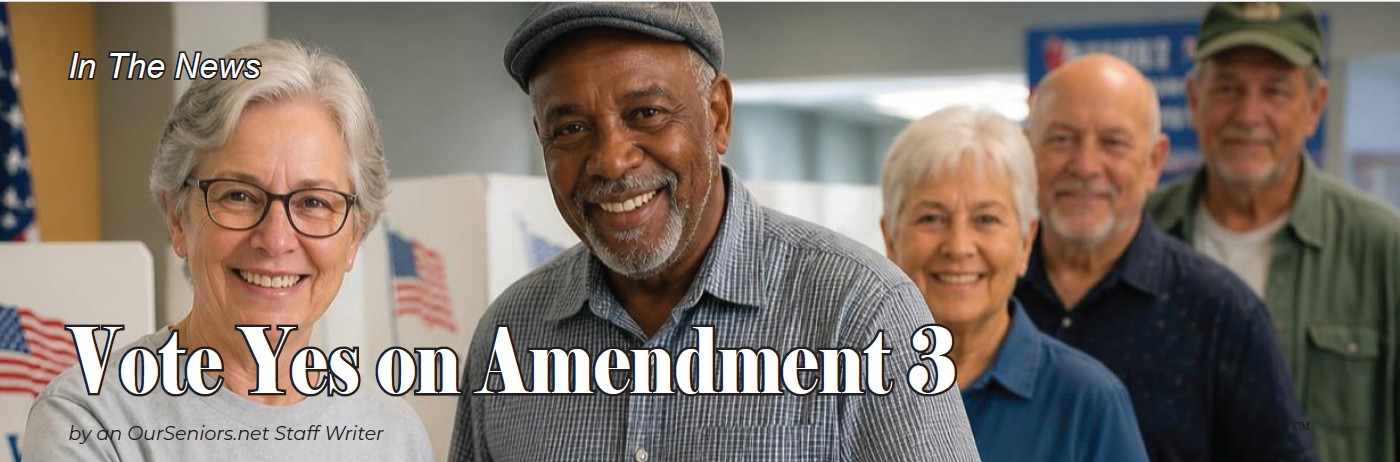
If you are referring to Florida’s Amendment 3 for 2026 in connection with property tax, there is a sound case for supporting it, despite some significant trade-offs. This amendment aims to increase the homestead exemption from $50,000 to $150,000 in 2027, and ultimately to $250,000 in 2028, which would lower the taxable amounts for qualifying homesteaded properties.
The strongest reasons to vote YES
1. Lower property taxes for homeowners
A notable benefit is the substantially higher homestead exemption.
Qualified property owners would experience a decrease in their taxable amount, resulting in a reduced property tax obligation, assuming local millage rates remain unchanged to mitigate the decrease.
2. Protects homeowners from rising housing costs
Property prices have surged considerably for homeowners in Florida. Increasing the exemption provides current property owners with better defense against rising tax assessments.
This is particularly beneficial for retirees and those living on fixed incomes.
3. Keeps more money for families in Florida
Supporters can frame this as a key principle: if the value of your home increases, the government should not automatically take a larger portion of your income through property taxes.
The amendment would constitutionally secure the larger exemption, rather than leaving it entirely to the future decisions of lawmakers.
4. It does not abolish property taxes
Voting in favor does not mean property taxes in Florida will disappear. It specifically boosts the homestead exemption.
Nevertheless, here is the primary opposing argument
The revenue must come from somewhere.
Local governments rely heavily on property taxes for critical services such as law enforcement, fire services, infrastructure, stormwater management, and hurricane preparedness. Detractors claim that a diminished taxable property base may force local authorities to reduce services or raise other taxes and fees. It is guaranteed that these services will be funded by the basic property taxes that exist after the Homestead Exemption goes up.

Moreover, it’s important to note a significant distinction: the amendment primarily benefits individuals who own homesteaded properties. Renters do not receive the exemption directly, and some contend they could end up facing higher costs if local governments seek to recover lost revenue through alternative taxes or fees. Additionally, this issue isn’t just a political one: a Florida judge recently declared that the proposed ballot language was misleading and ordered a revision, meaning the exact phrasing voters will see could change. It will be available for November 3rd, as the judge can’t remove that from the ballot.
When is a YES most reasonable?
I would contend that the most persuasive argument for a YES is:
“I own my home, I wish Florida to provide stronger protections against rising property taxes, and I am willing to accept the possibility that local governments might need to adjust their spending, fees, or other taxes to recover some of the lost revenue.”
When is YES, the most reasonable choice?
I would contend that the strongest argument for a YES is:
“I possess my residence, I want Florida to implement more robust protections against rising property taxes, and I am ready to accept the possibility that local authorities may need to adjust their spending, fees, or other taxes to recover some of the lost revenue.”
Disregard all the excessive chatter out there; there’s a limit to it all. It’s quite straightforward: taxpayers should be homeowners, not lifelong renters. This idea is what Karl Marx expressed in his Communist Manifesto. If you’re skeptical, you can see it for yourself here: https://www.marxists.org/archive/marx/works/download/pdf/Manifesto.pdf
Check out page 56, Item 9. In regions where a tenant system is widespread, land rent or quit-rent should be paid to the government as tax.
This is America, where capitalism has sustained this nation for 250 years. Socialism, Marxism, and Communism have proven ineffective; a glance at history will show that. For instance, Fidel Castro had only 24 yachts…just read the real account: https://www.theguardian.com/world/2014/may/21/fidel-castro-lived-like-king-cuba
Floridians, it’s time to wake up and Vote Yes on November 3rd!
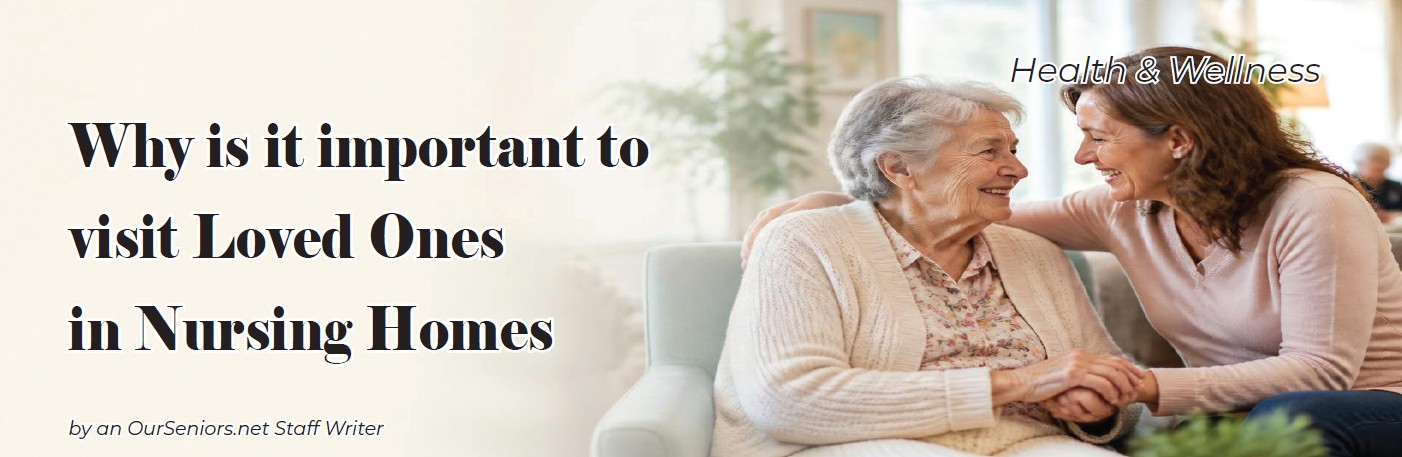
Visiting a family member in a nursing home is important because your presence can mean far more than you realize. As people age, they can lose friends, independence, mobility, and regular contact with the outside world. Family visits help remind them that they are still loved, valued, and part of the family.
Why visiting matters
It fights loneliness. Nursing-home life can sometimes become repetitive and isolating. A familiar face can brighten an entire day.
It provides emotional support. Knowing that family members still care can give an older person comfort, reassurance, and a sense of belonging.
It preserves family connections. Even when someone’s memory or abilities change, the emotional connection with family can remain incredibly meaningful.
It gives them something to look forward to. A planned visit can turn an ordinary week into something special.
It helps you stay connected to their life. Visiting lets you understand how they’re doing—not just physically, but emotionally.
It creates memories. A conversation, a favorite meal, looking through old photographs, listening to music, or simply holding their hands can become precious moments.
It reminds them they’re not forgotten. Perhaps most importantly, walking through that door says: “You matter to me.”
Don’t worry about making every visit special!
You don’t need to spend hours or come with an elaborate activity. Sometimes 15–30 minutes of genuine attention is enough.
Sit beside them. Ask about their day. Bring a photograph. Read something together. Watch their favorite television program. Take them outside if they’re able. Or simply sit quietly and hold their hand.
For a family member in a nursing home, your visit may be one of the most important parts of their week.
They may not remember every conversation you have, but they can remember how your presence made them feel.
And someday, you may be very grateful that you took the time to walk through that door as you may end up in a facility yourself! At OurSeniors.org we love OurSeniors and please don’t forget to check out our resources such as articles, vendors you name it. Bring a smile to someone, that could make a huge impact on their health.


Sally Birsinger of Jupiter, Florida, has spent 91 years quenching her thirst for knowledge. A shining example of how to age adventurously, Sally shares an inspiring message: Curiosity has no age limit. From the time she retired nearly 30 years ago, many of Sally’s most meaningful experiences have taken place with her husband Rand by her side.
In fact, the story of her first big adventure across the globe in 1999 is one that Sally still talks about — a three-week journey through China with Road Scholar, the not-for-profit educational travel organization for adults. Sally says the unforeseen circumstances at the start of that trip taught her early on to embrace the unexpected. “When we left the West Coast of the United States, we were delayed because of a typhoon off the main coast of China. As a result, we ended up losing our luggage for almost a week. This, however, did not spoil our enthusiasm for the adventure as we enjoyed Shanghai and Beijing anyway,” says Sally. “Then we flew west (with our luggage) and explored sights along the Yellow River, traveled farther west toward the Gobi Desert and then headed south into the Tibetan area. It was an amazing experience!”

Sally says it was the feeling of being so well taken care of on that far-flung journey that hooked her on trying to see as much of the world as possible. “Our local Chinese study leader on that program shared much of his life’s personal experiences with us. We traveled on interior airlines and buses throughout China, had great lectures and cultural immersion and ate delicious local meals,” Sally reminisces.
Sally quickly realized that the education she received on these trips was more fulfilling than mere sightseeing. She also came to cherish the unexpected connections and friendships she formed along the way with fellow group members. “Rand and I met and made friends with others who later traveled with us. And they, in turn, encouraged other friends to travel with us, too.”
With many memories from around the world now pared down to a few precious photos saved in cherished scrapbooks, one of the most special stories Sally shares is about the trip she took most recently.
What was meant to be a simple three-day jaunt to Louisiana when she turned 90 turned out to be an experience she’ll never forget. Originally planning to simply meet up with Rand’s relatives for a long weekend, Sally decided to enrich their time there. So, always on the lookout for another chance to satisfy her curiosity, she signed up for New Orleans at a Slower Pace, tacking on five extra days to that long weekend just for the opportunity to learn more about the area.
“Our hotel was in the French Quarter, the lectures, entertainment, food and even a cooking class were great! My husband was not well at that time, but he was able to participate and enjoy the activities. He passed away several weeks after we returned home, but we never regretted taking that last adventure with Road Scholar,” Sally shared.
Nowadays, faced with the challenges of adjusting to a life without Rand, Sally continues to remain curious and continue quenching her thirst for knowledge. She now takes advantage of Online Lectures and also takes OSHA classes at FAU. And she says the good friends she and her husband made on their trips remain her friends to this day. Sally is also blessed to enjoy quality time with her children and grandchildren, who sometimes whisk her away on a road trip, knowing how much she still enjoys getting out to experience life.
We wish Sally all the best in her 92nd year. And may we all take away a few lessons from her story by staying curious, continuing to learn and cherishing our most meaningful relationships. Thank you, Sally, for being such a shining example to us all.

Currently, over 65 million individuals are looking after older relatives or elderly acquaintances. This represents around 29% of the total population. This group can include anyone who is advancing in age, dealing with long-term health issues, or is disabled. This shows that a significant part of society is responsible for taking care of older adults, which is a natural aspect of life since everyone eventually grows older. Although this is a common experience, many people are unsure about how to deal with such situations or manage their responsibilities effectively.
Many individuals are left contemplating what actions to take when they need to care for an elderly parent or grandparent who can no longer live independently. It’s important to understand a few crucial points when you take on the caregiver role because there are choices available that can help clarify and ease the challenges associated with supporting a senior when you feel unprepared.
Continue reading to learn what you need to know if you intend to organize care for aging parents or any elderly individuals in your life so that you can approach the process with greater ease.
Establish Your Plan
If you find yourself needing to care for elderly parents or any older adults, the very first step is to figure out your plan. To care for aging parents or seniors, it’s important to evaluate their individual requirements. Not every senior needs the same kind of support, and knowing their specific circumstances is crucial to handling each situation effectively.
Some older adults might only need help with everyday activities, while others could require more comprehensive medical attention. Have a conversation with your loved one to discuss their wishes, challenges, and health concerns to design a personalized care plan.
In essence, the best way to begin is to identify what they require. For instance, does the senior have trouble moving around, and will you not be available during the day? In such cases, it may be worthwhile to look into assisted living options or even explore nursing homes or communities for seniors. The issue might be as straightforward as finding a solution that provides your elder with supervision when you cannot be there.
They might just need some support during the day or assistance with their mobility as necessary. Developing a senior care plan is the next logical step. This will involve organizing care resources, ensuring their home is safe if they choose to stay there, and discovering ways to make the aging journey more manageable.
Explore Active Care Choices
After you clearly understand what your loved one needs; it’s time to look into the care choices available for them. In doing this, it is important to consider their likes and dislikes to guide you. The kind of care needed can differ from one individual to another, so it’s essential to think about things like budget, location, and what is generally accessible. Below are some typical care choices you should think about.
In-Home Care Could Be A Suitable Option
Taking care of elderly parents or seniors in your life is a big responsibility that many of us will encounter eventually. It’s important to tackle this role with kindness, patience, and an awareness of the difficulties that come with it. To ensure seniors receive the best possible support, it’s vital to learn about the care process and what resources are available. One common choice is in-home care since many seniors prefer to stay in their own homes as they grow older.
Staying in their own home is favored because it allows them to remain in a familiar place, which can also be more affordable. This option enables your loved one to stay in their own house while getting help with daily chores and health needs. Essentially, you bring support to them instead of moving them elsewhere.
Consider Assisted Living Homes
These homes offer a helpful setting for seniors who need some assistance with everyday tasks but still want to have some freedom. The space is safe while focusing on allowing seniors to maintain their independence instead of moving them to a place where everything is managed for them.

Nursing Homes May Be A Consideration
For seniors who have more complicated medical needs or those who need constant care, nursing homes provide extensive services. These services are beneficial for aging parents facing physical challenges or health decline. It is often difficult to manage these kinds of issues on your own, which is why seeking help from nursing homes or more specialized care is always a wise option.

Think About the Advantages of Respite Care
If you are the main caregiver and need some time to recharge, respite care services can offer short-term relief. Respite care is a great choice for caregivers who seek a better life balance than they currently have. If you are new to looking after elderly parents, this could be your opportunity to lessen the stress that comes with such a role and help you avoid feeling overwhelmed or burnt out.
Adult Day Care; Is This A Good Choice For Your Family Member?
These facilities provide social activities and care throughout the day, which helps family caregivers manage work or other commitments. This serves as a great option compared to nursing homes, as you will receive support as the caregiver while remaining the main person in charge of care. Essentially, adult day care can ease the pressure on caregivers and support a healthy social life.
Things to Think About When Caring for Elderly Parents
If you start taking care of elderly parents, there are several other factors to think about. These include important legal issues and paperwork, advanced care preferences, and planning for assets. You should also think about financial authority, emotional and mental support, and long-term health insurance. Remember that providing care for elderly parents can have financial effects, so it is important to prepare and be aware of the expenses tied to the care option you choose.
Look into government assistance, insurance benefits, and other financial support sources to help with these costs. It might also be wise to speak with a financial expert to gain useful advice on handling these expenses, which can make it easier for you to proceed with this transition.
It Doesn’t Have to Be Hard to Manage
Caring for elderly parents is a big responsibility that can be tough, but it can also be extremely fulfilling when you think about it. By understanding what your loved one needs, looking into care options, and asking for help, you can handle this journey better and feel more at ease for everyone involved.
Keep in mind that you are not on your own; there are tools and communities to assist you in giving the best care to your elderly parents or any older adults in your life. Approach this role with kindness and commitment, and you will likely find that the task is not as overwhelming as you expected.
Disclaimer. The details shared on our website are meant solely for informational purposes. They should not replace professional medical advice. Not every inquiry submitted may receive a response. Always seek guidance from your doctor or healthcare professional for medical concerns. For further Disclaimer information, please visit https://ourseniors.net/disclaimer/
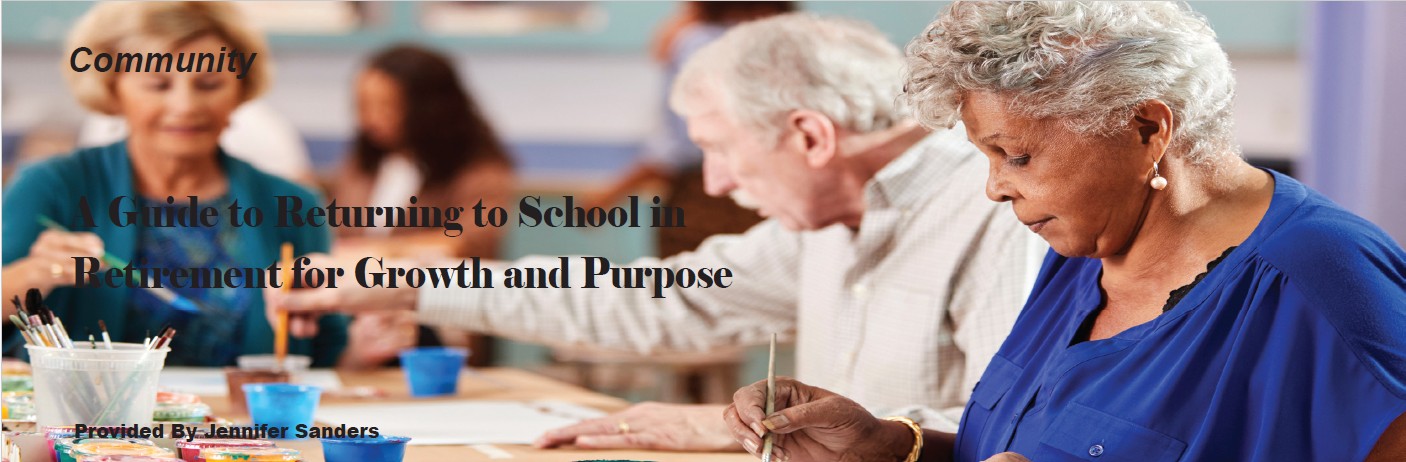
For retirees and soon-to-retire adults weighing on a return to school, the excitement of education in retirement often meets a real question: is this about personal joy, a deeper sense of purpose, or second career opportunities that still feel within reach? Adult education trends show more senior learners stepping into classrooms and online programs, but choosing a direction can feel surprisingly hard after years of being defined by a job title or family role. Lifelong learning benefits can include sharper thinking, new community, and a renewed sense of momentum. Getting clear on the “why” turns retirees returning to school from a vague idea into a confident next step.
Understanding What You Gain From Learning Again
Education in retirement works best when you treat it like a “what you gain” map, not just a hobby or a credential. It can bring mental challenge, routine, and fresh goals, and continuing your education can also strengthen confidence as you grow new skills.
This matters because sharper thinking and steady problem-solving can support long-term cognitive health, while classmates, group projects, and discussion boards add real social connection. When learning has a clear payoff, it’s easier to decide if you’re aiming for personal meaning, a second career plan, or a small business idea.
Picture a retiree who joins a class for curiosity and ends up leading a team presentation. That same person starts networking, testing an idea, and feeling more energized day to day. With the benefits clear, it helps to see what business coursework actually teaches.
Preview of an Online Business Degree: Skills That Power New Plans
That sense of purpose can feel even stronger when your learning is organized into a clear, flexible path. Earning an online degree lets you build momentum from home, keep your routines, and move through structured coursework at a steady pace, benefits that can make returning to school feel realistic in retirement. If you’re thinking about a practical pivot, a business management degree can strengthen skills in leadership, operations, and project management; a clear reference can help you preview what that kind of curriculum typically includes.
Weekly Habits That Make Retiree Study Life Stick
In retirement, consistency beats intensity. The habits below help you protect energy, keep family time intact, and make progress feel predictable even when life gets busy.
Two-Block Study Appointment
What it is: Schedule two 25-minute study blocks, then stop when the timer ends.
How often: 3 to 5 days weekly.
Why it helps: Short sessions reduce burnout and make it easier to restart tomorrow.
Sunday Plan and Spend Check
What it is: Review tuition, fees, and subscriptions using the fact that many retirees wish they had saved more for retirement.
How often: Weekly.
Why it helps: You catch budget leaks early and avoid stressful surprises mid-term.
One-Question Discussion
What it is: Share one question from class with a friend, partner, or grandkid.
How often: Twice weekly.
Why it helps: Talking it out strengthens recall and keeps learning social.
Brain Warm-Up Notes
What it is: Write five lines summarizing yesterday’s lesson to build cognitive exercise habits tied to cognitive impairment.
How often: Before each study session.
Why it helps: Quick retrieval practice improves focus and confidence.
Boundary Phrase Practice
What it is: Rehearse a simple line like “I can help after my study time.”
How often: Daily.
Why it helps: Clear boundaries protect your schedule without straining relationships.
Questions Retirees Ask About Going Back to School
Q: How can I budget for tuition without stressing my retirement plan?
A: Start by pricing the full term, not just tuition, so you include books, tech, and fees. Set a firm per-semester cap and choose a pace that fits it, even if that means one class at a time. Ask the school about senior discounts, payment plans, and whether you can audit a course for less.
Q: What program should I choose if I’m not sure what I want yet?
A: Begin with one low-stakes class tied to a curiosity or problem you want to solve, then reassess. Many programs are built for adult learners, so it’s normal to explore before committing. A meeting with an academic advisor can help you compare certificates, degrees, and noncredit options.
Q: Should I take online classes or go in person?
A: Choose online if you need flexibility for travel, caregiving, or energy fluctuations, and choose in person if you learn best through routine and face-to-face discussion. Try one course in each format if you can, then pick what feels easiest to sustain week to week.
Q: How much time will school realistically take each week?
A: A common starting point is 5 to 8 hours weekly for one course, but it depends on reading load and how quickly you write. Before enrolling, request the syllabus and count the recurring tasks so you can map them onto your calendar.
Q: Can going back to school actually help me work again or is it mostly personal enrichment?
A: It can do either, but clarity comes from choosing programs with visible outcomes like portfolios, internships, or industry credentials. Since only 22% of institutions have taken steps to implement skills-based learning, ask direct questions about job-ready projects and employer connections before you enroll.
Turn Retirement Curiosity Into One Clear School Decision
Wanting to go back to school in retirement can feel exciting and complicated at the same time, cost, time, and the “will I fit in?” is a real concern. The steadier path is a lifelong learning journey that matches today’s goals and energy, not yesterday’s expectations, using the same practical thinking you’d use for any big family decision. When that mindset leads, educational opportunities for seniors become less intimidating and more empowering, with reflective learning benefits that show up in confidence and connection. One small step toward learning is still progressing.
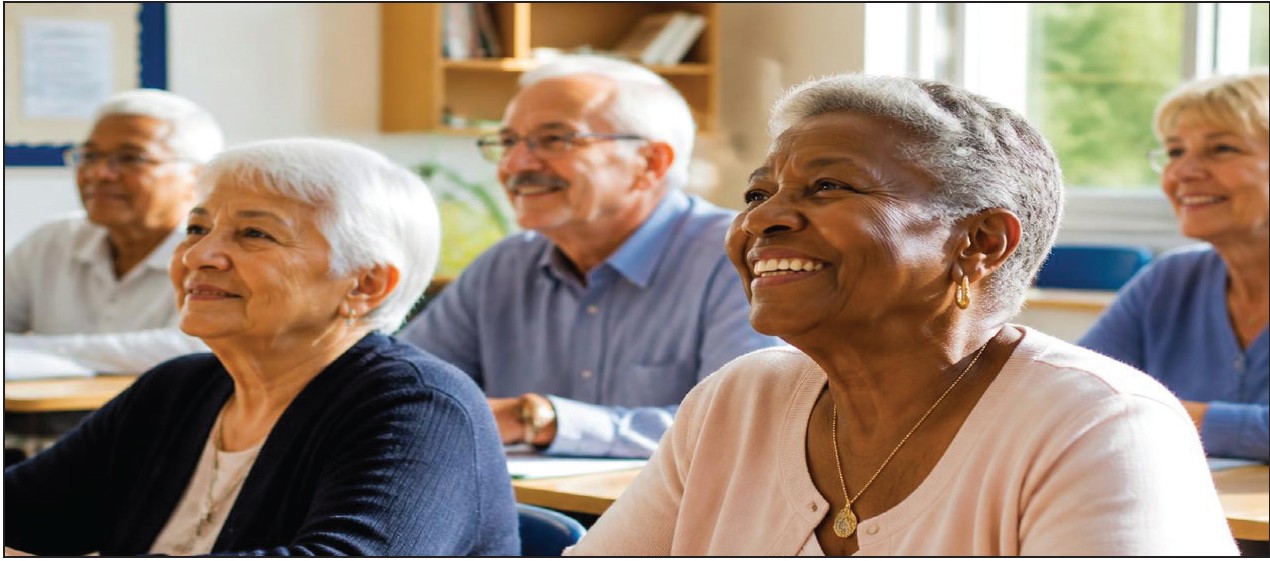

For older adults who want to stay independent and engaged, the hardest part of aging often isn’t health, it’s the quiet pressure to stop trying new things. When routines shrink and the world changes fast, adaptability in aging can feel like a test that’s easy to fail, which can chip away at confidence in later life. Lifelong learning offers a different story: small, steady new experiences can rebuild trust in one’s own abilities. That mindset opens room for personal growth for seniors.
Understanding Lifelong Learning After 60
Lifelong learning means choosing small, intentional stretches that keep your mind flexible and your options open. One clear definition calls it intentional learning activities that build knowledge, skills, and competence over time. It also includes technology, not as a trend to chase, but as a practical tool for everyday choices.
This matters because learning supports mental agility and reduces the need to rely on others for simple tasks. Confidence grows when you can compare information, solve a minor problem, or try again without feeling stuck. Over time, those wins protect independence and make change feel more manageable.
Think of it like keeping a “life toolbox” updated. Learning a new app is like adding a better flashlight: it helps you check a bill, confirm an appointment, or spot a scam before it costs you. With that foundation, it gets easier to compare tools, platforms, and communication options that fit your comfort level.
Tech and Learning Options Compared After 60
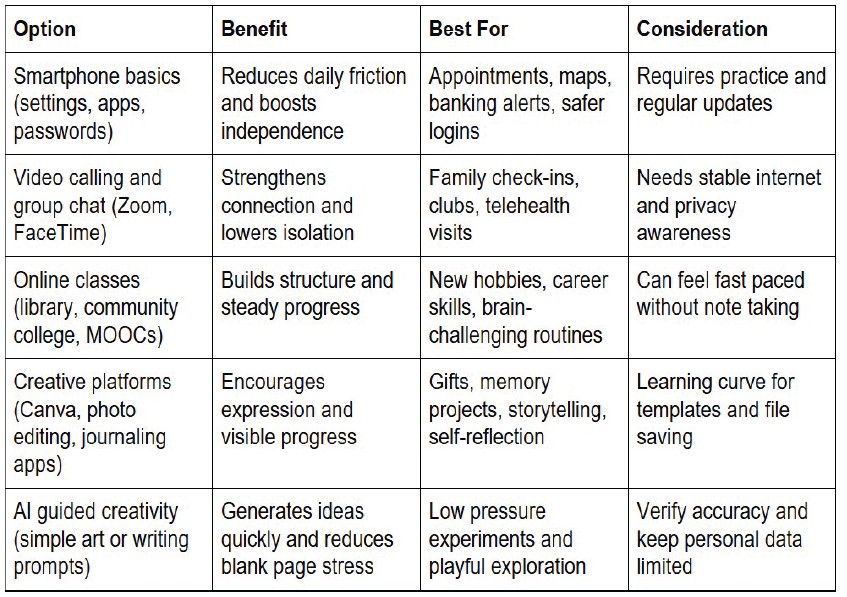
Not every option builds confidence in the same way. The table below compares practical digital tools, creative platforms, online learning options, and modern communication methods so you can match the right starting point to your comfort level and goals.
If your priority is independence, start with smartphone basics; if it is belonging, begin with video calling. When motivation dips, choose the option with the shortest setup and the quickest payoff. Knowing which option fits best makes your next move clear, and the next section will offer small, safe experiments to try this week.
Try 7 Low-Pressure Ways to Practice New Digital Skills
You don’t need a big “tech makeover” to grow your confidence. Small, repeatable experiments, chosen to match your goals for learning, creativity, or connection, can help you feel capable fast.
Do a 10-minute safety and comfort setup: Turn on automatic updates, set a screen lock (PIN or fingerprint), and review your device’s privacy settings. Then create one strong password phrase you can remember and write it on a paper “master list” stored somewhere safe at home. This works because you remove the biggest fear, “what if I mess something up?”, before you practice anything else.
Pick one everyday skill to check and strengthen: Choose a short list to evaluate, such as assess skills in web browsing, using apps, and basic settings, then circle just one weak spot. Practice that single item for 15 minutes a day for one week, nothing more. This builds momentum because you’re improving one measurable skill instead of juggling five.
Create a “help me later” folder and contact plan: Make a folder called “Tech Help” and save screenshots of your Wi‑Fi name, your device model, and any important account recovery info (like backup email or phone number). Add one trusted person to your contacts as “Tech Buddy,” and draft a message you can reuse: “Can you help me with one quick question? I’ll send a screenshot.” You’ll feel calmer knowing you can ask for help clearly.
Get a quick communication win in three messages: Send one text, one photo, and one short voice message to a friend or family member. Keep it simple: “Thinking of you,” then a photo of something ordinary (a meal, a garden, a pet), then a 10‑second voice hello. These small sends build social connections through technology without the pressure of a long call.
Join one low-stakes group space for connection: Choose a moderated online community tied to your interests, books, local events, walking groups, or a hobby, and read quietly for two days before posting. On day three, leave a friendly comment or ask one practical question. This mirrors the “options compared” idea: you’re selecting a platform based on comfort level and the kind of connection you want.

Take a 20–30 minute “micro class” and practice immediately: Pick a short lesson on one topic, photo organization, video calls, or online shopping basics, and complete it in one sitting. Right after the lesson, do one real task (organize 10 photos, start one video call, or compare prices for one item) so the skill sticks. Short classes work well because they reduce fatigue and give you a clear finish line.
Try a guided AI art postcard to share with someone: Use a simple, beginner-friendly AI art tool such as a free AI art generator and start with one prompt: “A cozy beach sunrise in watercolor style” or “A cheerful garden in bright colors.” Save the image, add one sentence in a note or email (“This made me think of you”), and send it to one person. Creative technology activities like this build confidence because there’s no “wrong” outcome, just exploration and a chance to connect.
Tech Confidence After 60: Common Questions
Q: What if I’m “too old” to learn tech or new skills?
A: That belief is common, but it is not accurate. The idea of an inability to learn new things is a myth, and many adults keep learning well into later life. Choose one small task that matters to you and repeat it a few times instead of trying to master everything.
Q: Why do I feel anxious even before I tap the screen?
A: Nervousness is not a character flaw, it is a normal stress response. Research links technology anxiety with age, which means you are not alone in this feeling. Start in “practice mode” by exploring one setting, then stopping before you feel overwhelmed.
Q: How do I stop fearing I’ll break something or get scammed?
A: Set up basic protections first: updates, a screen lock, and a simple plan for passwords. Then practice in low-risk areas like photos, notes, or voice messages. If something looks suspicious, pause, close it, and ask a trusted person before clicking.
Q: What should I do when frustration hits and I want to quit?
A: Treat frustration as feedback that the steps are too big. Take a short break, then restart with one tiny goal like “open the app” or “find the back button.” Writing down the exact words you see on the screen also makes it easier to get help.
Q: Can past bad experiences with computers mean I’m just not good at this?
A: Not at all, it usually means you were taught too fast or without support. Pick one patient “tech buddy” and agree on a simple routine: one question at a time, plus screenshots. Progress comes from consistency, not from perfection.
Turn New Skills Into Confidence With One Weekly Habit
It’s easy to feel behind when technology changes fast, especially after a few frustrating attempts or fear of making mistakes. A positive aging mindset doesn’t deny those feelings; it leans on curiosity and adaptability so learning stays gentle, realistic, and ongoing. With that approach, empowerment through learning grows quietly, confidence returns, independence expands, and personal growth at any age feels possible again. Small learning, repeated often, builds the confidence that age can’t take away.
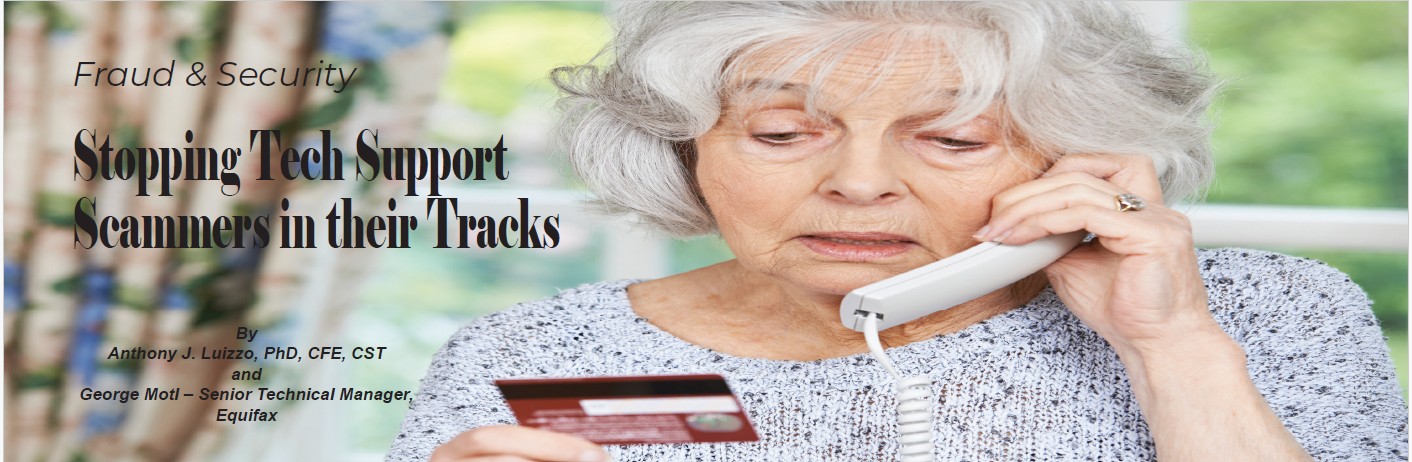
Scamming is an equal-opportunity business, and bogus tech-support services aimed at older adults have become an especially profitable form of fraud. According to the FBI Internet Crime Complaint Center (IC3), people age 60 and older reported approximately $1 billion in losses from tech/customer-support fraud in 2025, making it the second-highest fraud category by reported losses for that age group, behind investment fraud.
How do these scams’ function?
Fake pop-ups suddenly appear claiming that a computer is blocked, infected, or compromised.
A fraudster poses as a technician from a recognized technology company, financial institution, or government or law-enforcement agency and offers immediate help.
The victim is pressured into granting remote access to the device. Once connected, the criminal may view files, observe activity, install remote-management or malicious software, capture credentials, or manipulate what appears on the screen.
Scammers may claim that bank accounts or personal information are connected to illegal activity and use fear or urgency to keep the victim from independently verifying the story.
Some schemes evolve into refund or “overpayment” scams in which the criminal falsely claims too much money was returned and demands repayment by wire transfer, gift card, cryptocurrency, cash, or another difficult-to-reverse method.
How to protect yourself from becoming a victim
Never call a phone number displayed in an unexpected pop-up warning.
Never grant remote access to an unknown or unverified technician.
Treat urgent demands, threats, and pressure to act immediately as warning signs.
Independently verify the organization using a phone number or website you already know to be legitimate.
Never send money, gift cards, cryptocurrency, cash, or banking credentials merely because a caller says your account or computer is in danger
Note: If you suspect that you are being victimized, end the conversation and contact someone you trust.
Tech-Support Tips: What to Do After Remote Access Has Been Granted
Disconnect from the Internet immediately: Turn off Wi-Fi or unplug the Ethernet cable to interrupt the scammer’s remote connection.
Shut down the device: If you believe the attacker still has access, power down the computer to stop the active session and reduce the opportunity for additional changes.
Contact your financial institutions: Use the phone number printed on the back of your debit or credit card or another independently verified number. Explain that your computer may have been remotely accessed and ask what protective steps are appropriate.
Change exposed passwords from a different, trusted device: Prioritize email, banking, financial, and other sensitive accounts, and enable multifactor authentication where available.
Have the affected device examined: A qualified professional should check for remote-access tools, malicious software, altered security settings, and other persistence mechanisms before the device is trusted again.
Preserve evidence: Keep emails, phone numbers, screenshots, receipts, transaction details, and other information that may help investigators or financial institutions.
Where to Report Fraud?
Internet and online fraud should be reported directly to the FBI’s Internet Crime Complaint Center (ic3). Non-internet fraud should be reported to The Federal Trade Commission at reportfraud.ftc.gov / or to your local police agency and the state attorney general. The National Elder Fraud Hotline can be reached at 833-FRAUD-11 (833-372-8311).
Be Aware of Other Prevalent Scam Types Targeting Older Adults
Investment & Cryptocurrency Scams: Fraudsters promise unusually high returns or low-risk opportunities, build trust over time, and direct victims to fraudulent investment platforms or accounts.
Government & Business Imposter Scams: Criminals impersonate government agencies, financial institutions, utilities, or well-known businesses and use threats or urgency to demand payment or personal information.
Romance & Confidence Fraud: Criminals create false identities and build emotional relationships before inventing emergencies, investment opportunities, or other reasons to request money.
Grandparent & Family Emergency Scams: Scammers impersonate a relative—or someone supposedly helping that relative—and claim there is an urgent arrest, injury, travel, or other emergencies. Artificial intelligence and voice-cloning can make impersonation more convincing.
Fake Sweepstakes & Lotteries: Victims are told they have won a prize but must first pay taxes, processing fees, shipping charges, or other expenses to receive winnings that do not exist.
Asset Recovery Scams: People who have already lost money are targeted again by criminals posing as investigators, attorneys, or recovery specialists who demand upfront fees to recover the original loss.
A Simple Rule to Remember
Always keep your eyes on the prize and bear in mind that no legitimate technology company, bank, or government agency would ever pressure you into giving an unknown person remote access to your computer. It’s important to remember to never make important decisions when your dust is up and blowing and you are under pressure – take a deep breath and think it through – then make your decision!
About the authors
Anthony Luizzo, PhD, CFE – Investigative Sleuth / Lecturer: Seniors Vs Crime Project (a special program of the Florida Attorney General)
George Motl – Senior Technical Manager, Equifax


Now that we’ve entered the artificial intelligence age, staying free of the scammer’s deadly web is more important than ever. It is said that a single strand of spider-web silk is thinner than a human hair; but five times stronger than a same-size strand of steel. A routine method of not getting conned, bamboozled, hoodwinked, hornswoggled, and/or trapped in the scammer’s labyrinth of deadly cobwebs is to begin practicing better defensive security strategy. Like the dynamic crooner Tom Jones said in a 1968 hit ballad Delilah: “I felt the knife in my hand, and she laughed no more” – scam victims would be wise to apply the scam cutting tips below with surgical precision and cut themselves free from the scammer’s deadly grip.
Some defensive action-oriented scam stopper tips include:
Constructing strong passwords and pins. A strong password should contain upper- and lower-case letters, numbers/symbols
Always keeping electronic devices updated
Never storing passwords, banking and credit card information on electronic devices for expiated future use
Never shopping on public WIFI
Never leaving credit card receipts at ATMs
Never unsubscribing from incoming e-mails
Always disabling smartphone “Auto Join”, WIFI, Bluetooth, and Personal Hot Spot settings whilst out and about
Always keeping track of incoming invoices
Routinely monitoring credit report activity
Enabling multi factor 2 Step authentication security
Always posting outgoing mail just prior to pick-up schedules
Installing mailbox alarms on residential roadside flagged mailboxes
Enrolling in the United States Postal Service’s “Informed Delivery Program” (it’s free)
Using “Gel Tip” pens when writing checks
Checking for suspicious looking and/or damaged QR Codes
Neglecting to secure chipped cards in RFID protected wallets and handbags
Never being too Quick to CLICK or SCROLL

Scam Prevention Alert
According to AARP (aarp.org), the five biggest scams to be on lookout for in 2026 include:
Employment Scams – targets desperate job seekers
Recovery Scams – assurances to recoup financial losses for a fee
Digital Arrest Scams – receiving calls claiming that you are the target of a criminal investigation
Hello Prevent Scams – fraudsters sending e-mails alleging that your computer /smartphone has been hacked
Romance Scams – Criminals creating fake profiles on social media sites to gain financial advantage
Other Scams to keep an eye out for include:
Sim Swooping & Hijacking Phone Number Scam – Scammers posing as delivery / support personnel for clients who have recently purchased a new smart device
QR Code Manipulation Scam – scammers replacing legitimate QR codes with malicious stickers to redirect users to malware rigged sites
One Time Password Bot Scam – fraudsters using bots to make automated calls that mimic bank fraud departments to trick victims into giving a one-time password to stop a fraudulent transaction
Social Security Imposter Scam – social security administration imposters contacting perspective victims by telephone falsely alleging that the victim’s social security card has been suspended due to suspicious activity
The Look Who Died Scam – A message or post claiming someone you know has died, with a link to a fake news article that steals account credentials or installs malicious malware software
Medicare and Health Insurance Scams – Fraudsters claim to be Medicare representatives, asking for personal details or charging for new medical cards to commit identity theft
Conclusion
As Billy Joe Shaver a famous country western singer was quoted as saying in a 1973 album “Old Five and Dimers Like Me”, it’s time for today’s older and younger five and dimers to start taking security and personal protection more seriously. The road to better security begins and ends with learning to be thermostats not thermometers (thermostats regulate temperatures, thermometers simply display temperatures). An excellent method of keeping swindlers, con artists, fraudsters, grifters and tricksters from entangling you in their deceptive netting is to surgically apply some or all of the defensive scam stopper strategies discussed herein. A good day to start turning the page on these rouge racketeers is ANY DAY THAT ENDS IN A “Y”!
About the author:
Anthony J. Luizzo, PhD, CFE – PUBLISHED AUTHOR (Retired NYPD)
Investigative sleuth / Lecturer – Seniors vs Crime Project – Volusia County Office
407 537-9509 / e-mail volusia@svcproject.org / website www.seniorsvscrime.com